Call for Proposals for the Indo-Burma Hotspot
- IUCN
- Apply by: ມີນາ 16, 2026
Funding Description
Call for Letters on Inquiry, Indo-Burma Hotspot
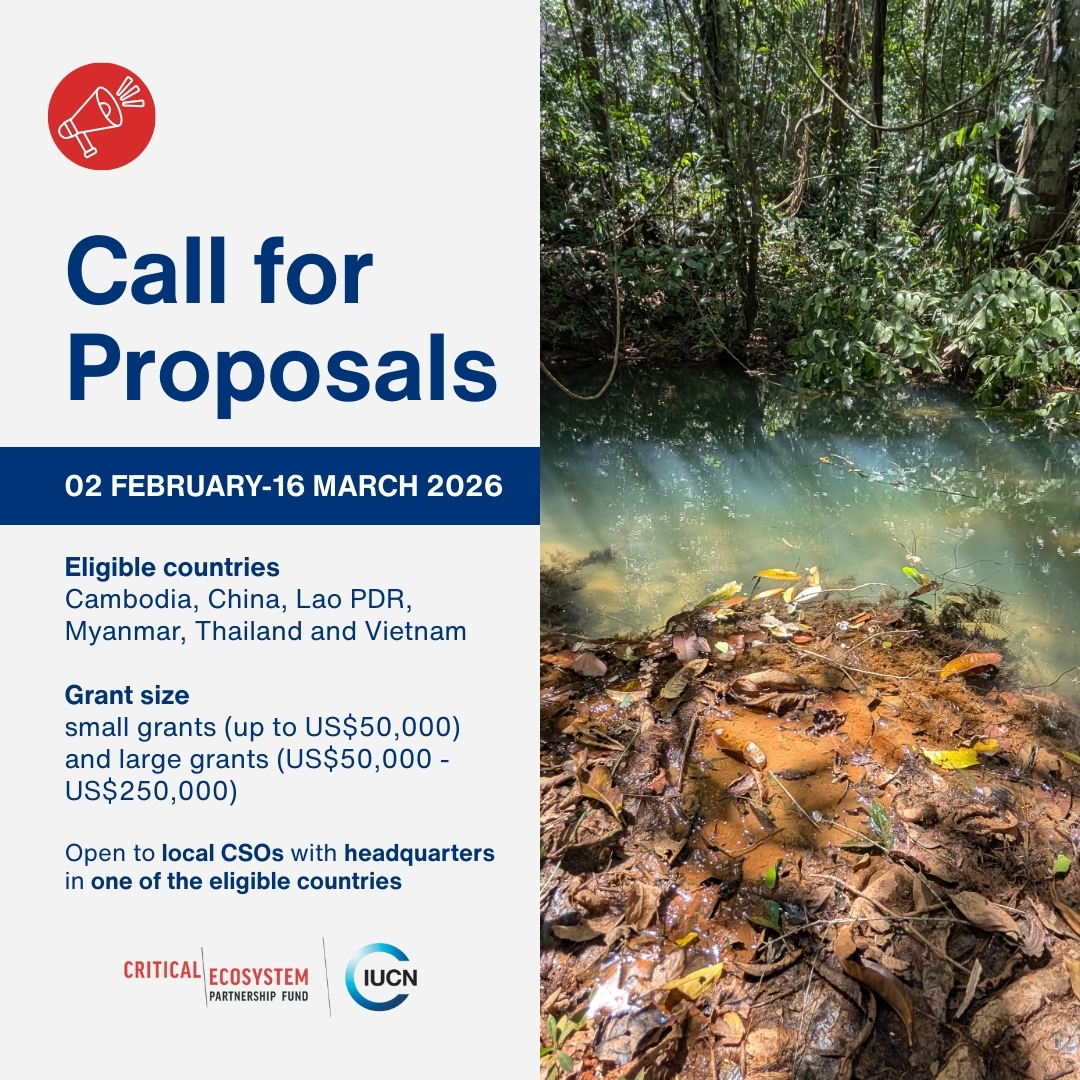
Opening date: 2 February 2026
Closing date: 16 March 2026
Grant size: small grants (up to US$50,000) and large grants (US$50,000 to US$250,000)
Eligible countries: Cambodia, China, Lao PDR, Myanmar, Thailand and Vietnam
Eligible priorities: Strategic Directions 3 and 6 and Investment Priority 9.1.
Eligible languages: CEPF accepts large grant applications in English, French, Portuguese and Spanish. IUCN accepts small grant applications in Burmese, Chinese, English, Khmer, Lao, Thai and Vietnamese.
This Call for Letters of Inquiry is available in Chinese, Khmer, Lao, Myanmar, Thai and Vietnamese:
cepf-indo-burma-call-for-proposals-feb2026_7-languages.zip
The Critical Ecosystem Partnership Fund (CEPF) and the International Union for Conservation of Nature (IUCN) are currently accepting Letters of Inquiry (LOIs) from non-governmental organisations, community groups, Indigenous People’s organisations, women’s groups, private companies and other local civil society organisations (CSOs) for projects that address the conservation of biodiversity in the Indo-Burma Hotspot, and that meet the criteria set out in this call.
CEPF is designed to safeguard Earth’s biologically richest and most threatened regions: biodiversity hotspots. CEPF is a joint initiative of l’Agence Française de Développement, Conservation International, the European Union, Fondation Hans Wilsdorf, the Global Environment Facility, the Government of Canada, the Government of Japan and the World Bank. In the Indo-Burma Hotspot, it is also supported by Margaret A. Cargill Philanthropies. A fundamental goal is to ensure civil society is engaged in biodiversity conservation.
The Indo-Burma Hotspot comprises all non-marine parts of Cambodia, Lao PDR, Myanmar, Thailand and Vietnam, plus parts of southern China. The current call for LOIs is limited to projects that address one or more of Strategic Directions 3 and 6 and Investment Priority 9.1. Another call will be launched in the second half of 2026, covering Strategic Directions 1 and 2 and Investment Priorities 9.2, 9.3 and 9.4. Future calls will be announced on CEPF and IUCN’s website and social media.
Preference will be given to projects that address the following criteria: (i) are the closest fit to the investment priorities eligible for support under this call; (ii) have a high likelihood of achieving their stated objectives and contribute strongly to sustainable conservation outcomes; (iii) build upon past initiatives and complement ongoing initiatives; (iv) represent good value for money; and (v) demonstrate the institutional capacity and experience necessary to carry out the work. CEPF welcomes applications from current and past grantees, as well as organisations that have not previously received CEPF funding.
Please note that this call is restricted to applications from local civil society organisations, which are defined as independent organisations headquartered in one of the six countries of the Indo-Burma Hotspot.
Applicants are strongly encouraged to familiarise themselves with the Ecosystem Profile for the Indo-Burma Hotspot, and to contact the Indo-Burma Regional Implementation Team (RIT) at IUCN (email: CEPF-Indoburma@iucn.org) if they have any questions or wish to discuss project ideas. Applicants are further encouraged to visit the CEPF website, particularly the sections on Eligibility; Before You Apply; and How to Apply.
PRIORITIES ELIGIBLE FOR FUNDING UNDER THIS CALL
Strategic Direction 3. Strengthen the management effectiveness of Protected and Conserved Areas (PCAs) and the engagement of CSOs and Indigenous People and Local Communities (IPLCs) in their management and governance to improve conservation at priority sites.
NOTES: With the exception of Investment Priority 3.4, which focuses on Key Biodiversity Area (KBA) identification, to be eligible for support under this strategic direction, projects must: (i) focus on one or more of the priority sites in listed in Table 31 in the Ecosystem Profile; and (ii) demonstrate wellbeing benefits for local communities. Projects must also apply gender-responsive management practices that support women to increase their access to natural resources, as well as their participation in environmental decision making.
CEPF and IUCN invite proposals that address one or more of the following investment priorities:
3.1 Empower IPLCs and CSOs to participate in the governance of PCAs and to strengthen their rights and opportunities in broader resource management.
3.2 Enhance PCA effectiveness through the adoption of global standards and the development of accredited training programmes.
3.3 Empower IPLCs to lead and sustain Other Effective Area-based Conservation Measures (OECMs) through authentic local processes.
3.4 Update the KBA network by applying the latest IUCN Global Standard and guidelines to existing and potential new KBAs.
Strategic Direction 6. Implement scalable approaches for integrating biodiversity, ecosystem services and Nature-based Solutions (NbS) into development planning in priority corridors
NOTE: To be eligible for support under this strategic direction, projects must: (i) demonstrate scalable approaches that are suitable for replication by civil society or private sector actors, or for incorporation into government programmes; and (ii) focus on one or more of the five priority corridors and 24 Myanmar limestone karst KBAs listed in Table 31 in the Ecosystem Profile.
CEPF and IUCN invite proposals that address one or more of the following investment priorities:
6.1 Assess development policies and their impacts on biodiversity and ecosystem services and promote alternative scenarios, NbS and mitigation measures.
6.2 Implement and scale ecosystem restoration efforts, including demonstration projects, to generate replicable models and inform broader application.
6.3 Engage the media to increase awareness, inform public debate and influence decision-making on mainstreaming biodiversity into development planning.
Strategic Direction 9. Support the establishment, capacity and organisational development of civil society organisations to work on biodiversity, communities and livelihoods at regional, national, local and grassroots levels
NOTE: To be eligible for support under this strategic direction, projects must: (i) integrate gender considerations into their design and implementation and demonstrate strategies to promote equity in access to capacity building and organisational development; and (ii) ensure that the perspectives of women, Indigenous Peoples, youth and marginalized groups are embedded in coalitions and advocacy.
CEPF and IUCN invite proposals that address the following investment priority:
9.1 Support networking and knowledge exchange mechanisms, including mentoring partnerships between established CSOs and new or informal groups, that enable collective civil society responses to priority and emerging threats.
ADDITIONAL INFORMATION
This call is open to CSOs local to the Indo-Burma Hotspot. Individuals wishing to apply must work with CSOs to develop applications, rather than apply directly. Preference will be given to projects that actively incorporate gender considerations, in line with CEPF’s gender policy. Please refer to CEPF’s gender toolkit and gender factsheet for further guidance.
Grants cannot be used for: (i) purchase of land; (ii) removal or alteration of any physical cultural property (including those with archaeological, palaeontological, historical, religious or unique natural values); (iii) relocation of people or any other form of involuntary resettlement; or (iv) capitalisation of trust funds. All activities must comply with CEPF’s social and environmental policies, which can be found here. Please refer to CEPF’s safeguard video series for further guidance.
HOW TO APPLY
Applicants for small grants (up to US$50,000) can apply in Burmese, Chinese, English, Khmer, Lao, Thai and Vietnamese, using the offline template available below:
cepf-sg-loi-templates_chinese.zip
cepf-sg-loi-templates_english.zip
cepf-sg-loi-templates_khmer.zip
cepf-sg-loi-templates_lao.zip
cepf-sg-loi-templates_myanmar.zip
cepf-sg-loi-templates_thai.zip
cepf-sg-loi-templates_vietnamese.zip
Applicants are advised to prepare LOIs for projects that are 12-24 months in duration with an estimated start date of 1 July 2026. Completed LOIs should be sent as an e-mail attachment to CEPF-Indoburma@iucn.org. The file name of the LOI submitted should be as follows: Organisation acronym_country_CEPF SG Letter of Inquiry. For example, CCLM_Thailand_CEPF SG Letter of Inquiry. Receipt of the application will be acknowledged by e-mail. Applicants will be contacted thereafter as to how to proceed. Questions or concerns during this process can be sent to CEPF-Indoburma@iucn.org.
All LOIs submitted will first be screened to confirm their eligibility. Eligible LOIs will then undergo preliminary reviews utilising the criteria mentioned above. Based on these reviews, shortlisted applications will be further considered during a meeting of the National Advisory Committees (NAC) established in each of the Indo-Burma countries. Considering the recommendations of the NAC, decisions will be made on projects to receive funding.
Applicants for large grants (US$50,000 to US$250,000) must apply through CEPF’s online portal, ConservationGrants. First-time users will need to register to create an account. Applicants encountering any technical difficulties with the online portal should contact conservationgrants@conservation.org.
The first step in the application process is to submit an online LOI. LOIs can be submitted in English, French, Portuguese or Spanish. Applicants are advised to prepare LOIs for projects that are 12-24 months in duration with an estimated start date of 1 July 2026. Eligible LOIs will undergo technical review by the CEPF Secretariat and IUCN using the criteria mentioned above. Shortlisted applicants will be invited to present their projects to a Technical Review Committee in April 2026. Applicants will be subsequently informed whether they have been invited to the full proposal stage.
Detailed guidance on preparing a full proposal will be provided to successful applicants together with the letter of invitation. Successful applicants will be given four weeks to prepare a full proposal, through the online portal. During this period, they will be invited to attend a proposal development workshop, where they will have the opportunity to develop their proposals collaboratively, as a cohort, with guidance from CEPF Secretariat and IUCN staff.
All applicants must submit their LOIs by 11:59 PM Indochina Time (ICT) on 16 March 2026. LOIs received after this time will be rejected. Applicants will receive an email acknowledging receipt of their LOI at the time of submission.
Answers to Frequently Asked Questions (in English) may be found here. During February 2026, IUCN will be hosting online Information Sessions regarding this Call for Proposals. The relevant details will be posted to IUCN Asia’s social media accounts.
Further information and assistance can be obtained from:
CEPF Regional Implementation Team, IUCN Asia Regional Office,
63 Sukhumvit Soi 39, Wattana, Bangkok 10110, Thailand
Email: CEPF-Indoburma@iucn.org
Tel: +66 2 662 4029
ຕິດຕໍ່
- IUCN
- Call for Proposals for the Indo-Burma Hotspot
- conservationgrants@conservation.org.